For Zoe Schweiger, painting becomes a space of sensory memory, where heat, humidity, night light, and human closeness settle onto the canvas as naturally as color itself. Born and based in Miami, the artist turns her hometown into a quiet yet ever-present character within her work — a place shaped by extreme temperatures, environmental fragility, shifting social landscapes, and an energy that seems to dissolve the boundaries between body and space.
A graduate of the Maryland Institute College of Art (MICA), Schweiger has developed a figurative painting practice centered on the depiction of those close to her, captured in living rooms, queer clubs, bars, and other spaces of encounter and belonging. Through translucent layers of paint and softened contours, she constructs images that appear to dissolve under the pressure of heat, rain, or memory itself.
Distortion, blur, and the physicality of her painterly gesture are not merely aesthetic choices, but ways of speaking about vulnerability, intimacy, and transformation. In her work, bodies and environments continuously shape one another, and the viewer is drawn into the scene, invited to experience the atmosphere of the painting in an almost physical way.
With solo and group exhibitions presented across the United States and internationally, as well as numerous awards and works held in museum collections, Zoe Schweiger is among the participating artists in the exhibition In the Body Lies the Truth, a project that explores the body as a site of memory, identity, and expression.
You grew up in Miami, a city defined simultaneously by excess, climatic fragility, and a kind of social performativity. How do you feel this environment shaped the way you see the world, even before it shaped your artistic practice?
Well I think that all of those aspects can be said about any major city. Having grown up in Miami I think you see a different side of the city than what is shown from an outsider’s point of view. And even then Miami has changed SO MUCH since I was a kid. A lot of the city that has been “developed” in recent years aren’t necessarily the spaces I experience regularly. However, I think with the way the city has changed, the environmental fragility and the big developments that push so many locals out, has been something that I feel deeply about and ultimately affects my practice.
Do you remember an early moment when you first felt that an image could function as an emotional space, not just as a representation of something external?
I can’t remember the first time but I do remember taking a brief trip to the The Broad Museum after graduating high school and seeing a Jenny Saville painting in person for the first time. WOW. I think I cried a little, it was such a visceral feeling.
You studied interdisciplinary sculpture at the Maryland Institute College of Art, yet you came to work almost viscerally through painting. How did you come to feel that painting offered you something you couldn’t access through object or installation?
I started drawing and painting in high school and had been really intrigued by sculpture, installation, and works that are activated by the body in a physical space. However, when it came to object making I didn’t have the same emotional experience that I did while painting. I overthink a lot, and there’s something with painting that just feels so much more natural for me. I still love sculpture though and hope I can get back into it one day when the time feels right.
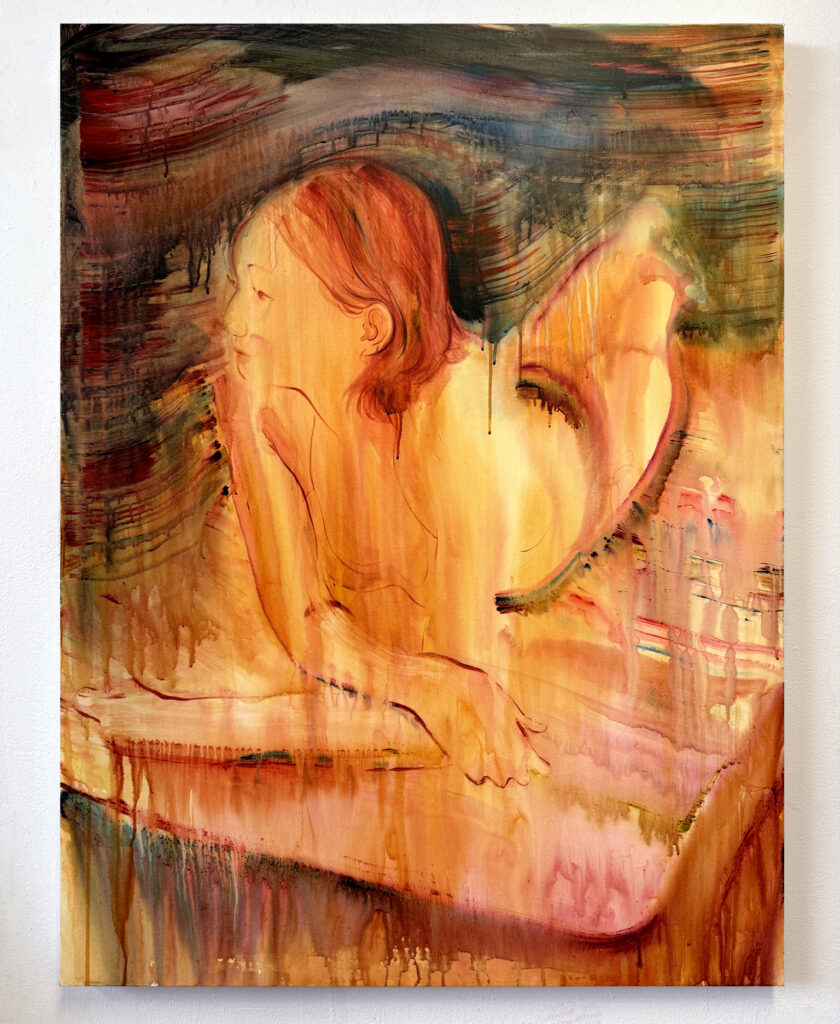
Many of your works seem to have a very physical relationship with the surface – as if the image is destabilizing or melting in real time. How would you describe the way you think about the materiality of painting, and to what extent does it come from a sculptural understanding of the body and matter?
I think in some ways it feels like im carving away at an image or im building up the image with paint. I think a lot about the term “decollage” which I first heard from Mark Bradford in describing the way he makes his artworks. Even though my work is currently pretty traditional; making figurative paintings on stretched gessoed canvas on a squared frame, I still see the canvas as a three dimensional object. I love when you can see the brush strokes that make their way onto the sides of the canvas and drip down and pool underneath.
What did your work look like before you began trusting blur, distortion, and ambiguity? What kind of image were you searching for then, and what felt like it still wasn’t working?
I’ve always been super drawn to distortion but rather than distorting with the material I was more focused on warping the image and painting in a much more opaque manner. It wasn’t until I started becoming more inspired by water, its fluidity and transparency, that my paintings started to become what they are today.
In art schools there is often pressure to intellectualize one’s practice very quickly. How did you navigate the tension between instinct and theoretical discourse during your formative years?
I honestly had a really tough time with it! Having gone to both an arts high school and college starting at age 14, I think it was helpful in some ways. It pushed me to think about what I was making and why, which is obviously an important part of art making. But I think at some points when I wasn’t really sure what I was doing it would almost paralyze me. It wasn’t until I finished school that I had the freedom to just make stuff without as much of the intellectual pressure. But those years were so informative and I wouldn’t have been able to make the way I do without so many years of critique and formal analysis. I’ll be starting grad school in the fall after taking four years off from school and I feel like I’m so ready to get back into that space.
How does the idea of emotional proximity in your work relate to a certain instability of the image and to what extent do you feel this tension reflects the experience of becoming an adult in a moment defined by overlapping climate, social, and identity crises?
I’ve technically been an adult for eight years now, but living during a time where there’s so much uncertainty plays a huge part in my work. I think it’s almost central to my work that there’s this sort of blurriness within the paintings and the lines aren’t super sharp. I think so much about the climate crisis, especially having grown up in South Florida and still currently living there. In just 20 something years I can feel the change so much and I’m always thinking in the back of my head; “will we be able to continue living here 50 years from now?” Plus living in Florida we’re dealing with newly written anti-environmental laws and laws like the “Don’t Say Gay Bill’ and worsening abortion bans, just to name a couple. All of these realities affect my work, even though they are not overtly mentioned.
What have you discovered about becoming an artist on your own, outside of art school, and what do you think can never be taught within an academic framework?
After graduating from art school four years ago, I’ve learned that art making can change and evolve just as we do. You don’t need to choose one thing to make work about for the rest of your life and you shouldn’t. And this may be stating the obvious, but one thing that can never be taught is passion and drive for creating.
How do you work with the idea of the sensory in your paintings – not just as a visual effect, but as a bodily experience you project onto the viewer?
One thing I’ve always loved about paintings where you can see the brushstrokes, or the hairs that stick to the canvas, or the little fingerprints here and there, is that it reflects the moment when the work was created. I think that alone allows the viewer to experience the painting as a more bodily experience.
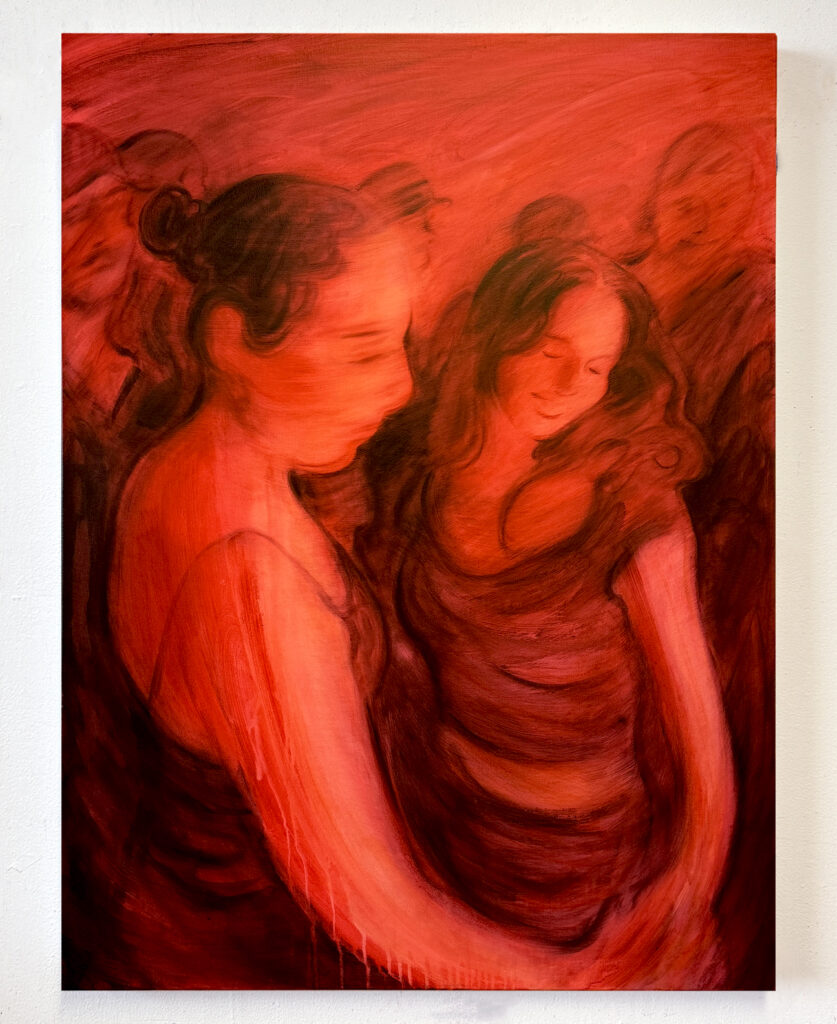
You speak about wanting your paintings to feel “humid” and “enveloping.” How do you translate these sensations into actual painting decisions, not just intention?
I paint with very watered down saturated layers of acrylic on a damped canvas. I’ll add a layer, wipe it off, let it drip down, and repeat until I’ve built up an image that feels reminiscent of paint sweating off the canvas.
You want viewers to almost feel skin, heat, smoke, and the warmth of night. How do you think about the relationship between the image and the body of the viewer?
I think it’s kinda fun to imagine that the viewer looking at the painting is within the scene that’s painted. All of the images I paint are from photos I take myself, so the paintings have a sense of my point of view. In some of my paintings you can see the elbow of someone reaching into frame or a body leaving the frame. Wherever the painting exists, it’s like the viewer is hanging out with the people in that painting.
How do you work with sensory memory – the recollection of sensations like heat, smoke, or humidity – when constructing an image?
Primarily with the blurring of the image. Heat, smoke, and humidity are all things that envelop, or sensations that shift how clear your vision is. When I’m remembering a night out for example, I’m often remembering more of the bodily sensations along with little snippets of images and lights flickering. My hair feels frizzy and is sticking to my neck, sweat collects above my upper lip, I can smell cigarettes and body odor and alcohol. It’s these quick little moments that I’m interested in capturing.
How did the invitation to participate in the exhibition “In the Body Lies the Truth” come about for you, and what resonated in your practice with this title?
Thom Oosterhoff reached out and pitched the idea to me! I resonated a lot with the concept of expressing through our bodies, and this idea that the way in which we create art can tell you a lot about a person.
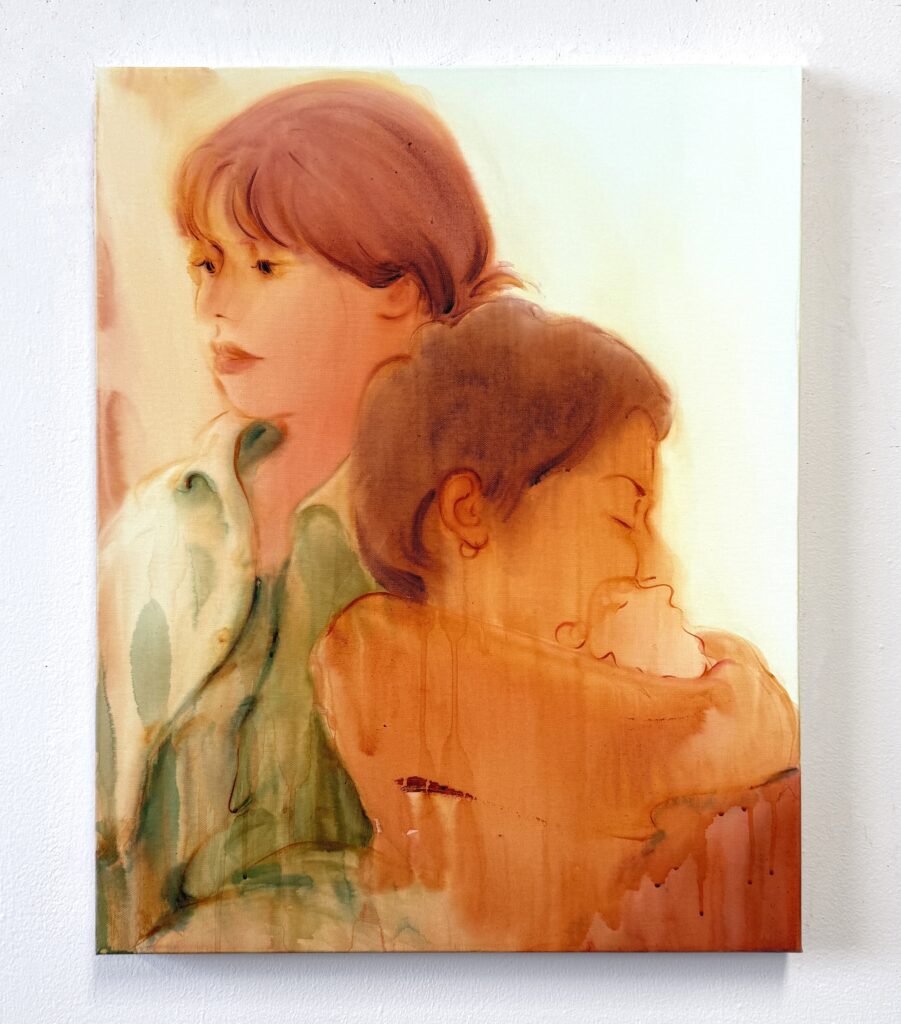
How would you describe, from your perspective, the energy and coherence of the exhibition “In the Body Lies the Truth,” and what place do you feel your work occupies within it?
All of the works feel very emotive even when there aren’t faces being shown. There’s the weight of a hand or an expressiveness in color or application in paint. Each painting in the show brings a different energy, but there’s almost this cohesive loneliness to the show. Although both of my paintings depict two people laying next to each other and dancing together, I feel as though there’s still this isolation, especially when my paintings are in conversation with the other artworks in the exhibition. I think it’s a lovely exhibition.
Tea or coffee? – Tea! Always
The most beautiful place you’ve ever traveled to: Amsterdam! It felt like a fairytale
Your working process in 3 words: Careful, joyful, orange
An unfulfilled dream: I’ve kinda always wanted to dj
Note to self: Stop thinking so much and just paint. It’s okay to “mess it up”
You can read the interview in Romanian here.
–
Redactor: Mara Lazăr